“This is it. I’ve got to get serious about my health.”
That’s what 60-year-old Kellie McConohay wrote in her journal after a routine doctor’s visit in November 2024 showed rising cholesterol, blood pressure and a number on the scale she didn’t recognize. A year later, at 61, Kellie is now unrecognizable in the best way: over 50 pounds down, stronger than she’s ever been and even back to slaloming on one water ski for the first time in decades.
The difference? Three intentional visits to our Edina Performance Lab, a team in her corner and a clear plan based on what her body needs to thrive in this next chapter of life.
Kellie has called Minnesota home for nearly 30 years, but these days she splits her time between the Twin Cities and Arizona. She’s a retired lawyer, a mom to a 29-year-old daughter in New York City and a snowbird who loves long walks through Manhattan in her free time.
Watching her parents, now in their mid-80s, struggle with orthopedic issues, including bad backs, poor posture and limited mobility, forced her to zoom out and ask a tough question: What do I want my aging to look like?
“The more I thought about it, the more I realized my health has to be my top priority,” she shared. “If I don’t have that, I can’t be there for other people, travel with my husband or someday get down on the floor and play with grandkids.”
Years earlier, Pilates had been her lifeline. She discovered reformer Pilates around age 40, when back pain sent her repeatedly to the doctor. Over time, consistent one-on-one instruction turned her core into what she jokingly calls her “401(k) for my body.” Heavy gardening, picking up large pots and day-to-day life became easier and pain-free.
But as the scale crept up through her 50s and into her 60s, Kellie knew Pilates alone wasn’t enough. She wanted more than “looking smaller.” She wanted strength, bone density and energy for the life she envisioned.
When her doctor’s labs flagged rising risk markers, Kellie decided to stop guessing. She went to Google with a simple question: What’s the best way to measure body fat?
That search led her to DXA scans, and DXA led her straight to our Edina Performance Lab.
“I didn’t just want to see a number on the scale,” she said. “I wanted to know my body fat, my bone density, my metabolism…everything. I wanted a real baseline, not just a feeling.”
On her first visit to Edina, Kellie chose a complete set of assessments:
Walking into a space with photos of endurance athletes, she felt a twinge of imposter syndrome. “My first reaction was, honestly, this place is for elite athletes, not for me,” she admitted. “But I decided to stay. I needed the truth more than I needed comfort.”
The truth was eye-opening.
She learned her body fat and visceral fat were higher than she wanted, and that her metabolism at rest was fueled roughly 50% from fat and 50% from carbohydrates. She had strong grip strength on her right side but a noticeable imbalance on the left. She also discovered something surprising: her maximal heart rate was far higher than the generic charts for her age.
Her personalized Zone 2, the “slow and steady” training zone that improves fat-burning and aerobic health was between 139–149 beats per minute. For most 60-year-olds using a generic calculator, that heart rate would be considered very hard work, closer to zone 4 or 5.
“If I hadn’t done the test, I would’ve thought I was helping myself just walking the dogs,” she said. “In reality, my heart rate wouldn’t have been high enough to change my metabolism. Knowing my real Zone 2 number changed everything.”
“If I don’t have my health, I can’t live the life I want.”

Six months later, Kellie returned to Edina for her second visit, a DXA check-in to make sure her weight loss strategy was protecting the things that matter to her, including muscle mass and bone density.
By then, she had already lost 40 pounds through intentional nutrition, consistent Pilates and structured Zone 2 cardio using her personalized heart rate zones. Her DXA scan revealed good news:
But the scan also revealed two critical opportunities:
Her performance physiologist, Kelly, suggested the missing piece: strength training.
Kellie was hesitant. Past experiences with personal trainers had ended in pain and injury. With two shoulder surgeries behind her, the idea of stepping into a weight room at 60-plus years old felt intimidating.
This time, she didn’t have to figure it out alone. Through our referral network, she was connected to Tony, a strength coach who partnered with her physical therapist’s guidelines (no overhead pressing, no tricep dips, no side planks) and built a plan around her body.
In June, she added two strength sessions per week to her Pilates and cardio routine, and everything began to compound.

Five months after starting strength training, Kellie returned to the Edina lab for her third visit, a full reassessment one year after her original baseline.
The numbers told a story of discipline, smart training and a body that was adapting beautifully:
For a woman in her 60s who had already lost over 50 pounds on the scale, preserving a strong metabolism and dramatically reducing visceral fat is no small feat.
“The team was genuinely excited,” she recalled. “When they pointed out how much my visceral fat had dropped, they told me they’d rarely seen a change that dramatic in that time frame. It was incredibly motivating.”
Outside the lab, her routine now looks like this:
She jokes that Pilates and lifting weights are “on the same team,” not competitors.
“Pilates keeps me long, aligned and strong through my core,” she said. “Strength training builds muscle and bone density. They make each other better.”

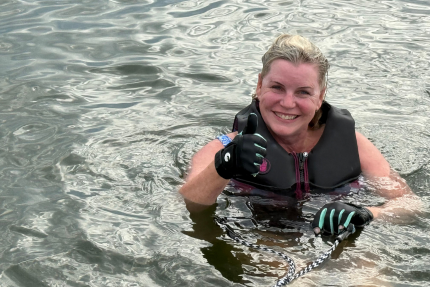
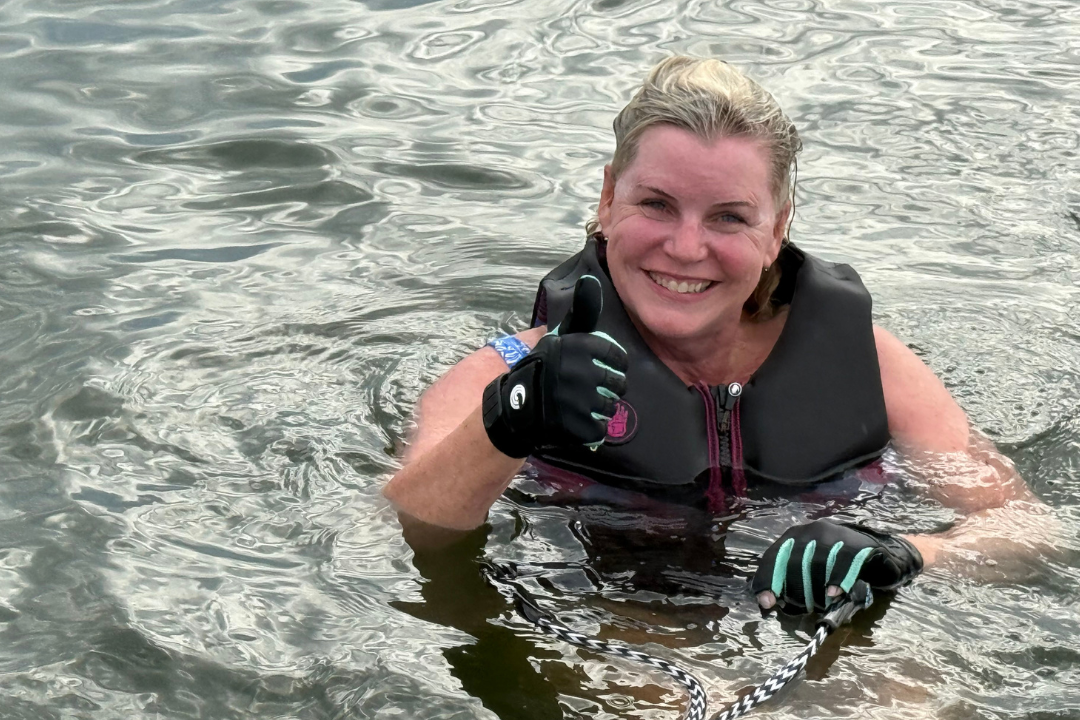
One of her biggest wins doesn’t show up on any dashboard but over Labor Day weekend, during a visit to her brother’s lake house in Kansas City.
Kellie set a goal with her trainer to get back up on one water ski, something she hadn’t been able to do in years.
Thanks to improved grip strength, leg power and confidence, she popped up on her second attempt.
“I almost threw the rope in celebration,” she laughed. “I was so proud. That moment alone made all the work worth it.”

Today, Kellie doesn’t talk about finish lines. She talks about lifestyle.
Her goals for the years ahead are simple, measurable and powerful:
“I want time freedom and physical freedom,” she said. “This isn’t a 12-week challenge. This is how I want to live.”

She knows there are countless women in their 50s and 60s who feel the same way she did a year ago. intimidated, unsure where to start and skeptical that real change is still possible.
To them, her message is clear: “It is never too late. Post-menopausal women can gain muscle. You can improve your health. And you don’t have to do it alone.”
If she had to describe Human Powered Health in one word, Kellie doesn’t hesitate: “Motivating.”
Wherever her journey takes her next, on the water, in New York City or between Minnesota and Arizona, we’ll be cheering her on. Like Kellie, we believe True Health is Self-Made.
Looking to rewrite the next chapter of your health and performance like Kellie?
Book your free 15-minute virtual consult with a performance physiologist to explore which assessments are right for your body, lifestyle and goals.
Human Powered Health is staffed with Master's and PhD-level performance physiologists who are dedicated to helping you improve your health and performance. Our product is a healthier you, and we have the science to make you better than ever.
Human Powered Health uses high-precision, research-grade technology for all assessments in order to provide a superior level of service and quality for anyone who wants to learn more about their health and performance metrics.
We are on a mission to power health and athletic performance for motivated humans. Your body belongs to you. You deserve accurate information about it. We give everyone the data and expertise to fine-tune their own health and athletic performance. Because knowledge is power, and true health is self-made.