

In 2018, Dave McGillivray was about as can be. As the Boston Marathon’s longtime race director, he’s logged nearly 150,000 lifetime training miles, run the course dozens of times, and built a career and a public identity around endurance. If anyone had earned the benefit of the doubt on cardiovascular health, it was him.
Then, he felt chest pain and shortness of breath during a training run. Testing revealed that he had severe coronary artery disease (CAD), driven largely by genetics, that had been progressing quietly for years. It wasn’t the kind of condition that shows up as a slower mile time or a missed workout. He underwent open-heart triple bypass surgery a few days later.
McGillivray put it best, saying, “Being fit does not necessarily mean being healthy.” His fitness was there, but so was his risk. Neither one canceled the other out, and nothing about how he looked, trained, or performed would have told you the second thing was true.
Here’s a closer look at the fitness vs. health conversation and how you can lean into it for trainer differentiation. Watch Dave tell the story himself:
Fitness tracks what you can measure: pace, strength, weight, etc. Your overall health includes what you can’t see: bloodwork, arterial health, genetics, and the physiological signals that a great workout can’t fix and a strong finish time can’t reveal.
Trainers are experts in the first category. The opportunity is connecting it to the second. The trainers who can do that become part of a client’s health picture, not just their fitness routine.
Dave trained consistently, performed at a high level, and felt strong. By every visible measure, he was in excellent shape. His story reminds us that how someone looks, feels, and performs can only tell you so much.
No Single test tells the whole story. The most complete picture comes from pairing objective performance data with the care a client receives from their physician. Tools like VO2 Max testing and DXA scans help fill in more of that picture, with results you can benchmark and track over time. Hard data means the same thing to the client, trainer, and physician, making it easier for everyone involved in a client’s care journey to stay on the same page.
If being fit doesn’t guarantee being healthy, does fitness still matter for health? The research says yes, by a wide margin.
A study of over 750,000 U.S. veterans published in the Journal of the American College of Cardiology found that cardiorespiratory fitness is one of the strongest predictors of all-cause mortality risk. It outperformed the traditional cardiac risk factors examined in the study. The least-fit individuals in the study carried roughly four times the mortality risk of the most-fit group across every age range and demographic studied.
These two ideas work together. Cardiorespiratory fitness is one of the most powerful health signals we can measure, and higher fitness is linked to lower risk across large groups. Dave’s story shows that fitness doesn’t cancel out every risk, especially ones driven by genetics. That’s why fitness belongs in the health conversation: measure accurately and consider it alongside the rest of a client’s health picture. Metrics like VO2 Max are more than training statistics; they are also meaningful signals of a client’s long-term health trajectory.
Traditional training models rely on the scale, a client’s appearance, and changes in how a person feels over time. While those are important indicators that a person is moving toward their goals, VO₂ Max gives you a ranking that compares your client to a specific population. You can track their progress over time and adjust your training regimen to hit meaningful targets.
Paired with a DXA scan as a starting point, it gives you and your client a clear picture of where they stand and what their next decade could look like, not just their next race. When a master’s-level exercise physiologist interprets that data, you get clear, actionable insight to build your programming around.
Retesting over time lets you and your clients see measurable progress. It also gives you objective results to share with a client’s physician, so everyone can see how training supports long-term health.
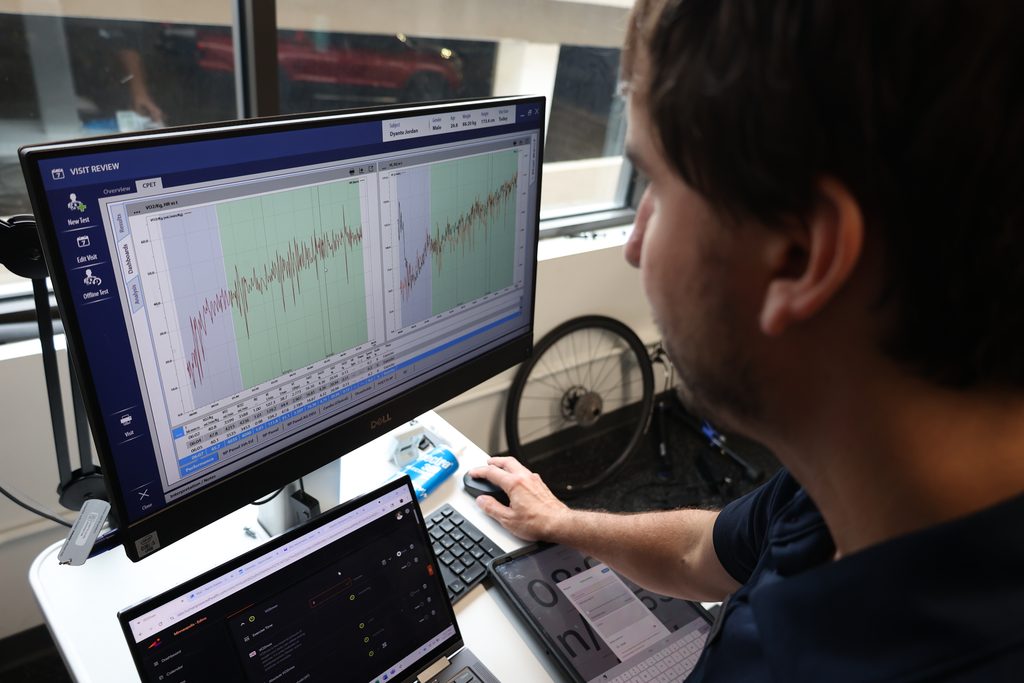
If you’re a health-minded professional who wants to see what VO₂ Max testing looks like in practice, Human Powered Health has you covered. Our team will walk you through our services, including VO₂ Max testing, DXA, percentile benchmarking, and how to turn a good program into a provable one with real-world data. Our exercise physiologists handle the testing and interpret the results, so you have clear data to inform the programming decisions you are already making for your clients.
Learn more about Human Powered Health or book a call with our partnerships team to explore what a partnership could look like for your practice.
True Health is Self-Made.
Human Powered Health is staffed with Master's and PhD-level performance physiologists who are dedicated to helping you improve your health and performance. Our product is a healthier you, and we have the science to make you better than ever.
Human Powered Health uses high-precision, research-grade technology for all assessments in order to provide a superior level of service and quality for anyone who wants to learn more about their health and performance metrics.
We are on a mission to power health and athletic performance for motivated humans. Your body belongs to you. You deserve accurate information about it. We give everyone the data and expertise to fine-tune their own health and athletic performance. Because knowledge is power, and true health is self-made.